01
Evidence Layer
Evidence registry
Records entities, atomic claims, precise sources, epistemic status, rationale, authorship, review, dates and rights.
→ Memory TwinStudio
Evidence-to-Story prototype · In development
Memory Twin Studio is an independent Museyoum initiative exploring an Evidence-to-Story workflow: existing sources become curator-reviewed narrative experiences without hiding claims, uncertainty, responsibility or rights.
One illustrative corpus. Multiple narrative paths. The evidence remains inspectable.
The product architecture
The prototype is designed to work with catalogues, archives, field records and, where available, existing 3D documentation. It does not replace repositories, catalogue systems or digitisation workflows.
Evidence registry
Records entities, atomic claims, precise sources, epistemic status, rationale, authorship, review, dates and rights.
→Curated narrative engine
Proposes and sequences narrative units that cite approved claims. It may surface connections, but it does not create evidence or approve publication.
→Experience composition engine
Assembles approved units for web, audio, audiovisual or spatial outputs while preserving access to their evidence cards.
The generative boundary
In this prototype, generative methods are used for discovery and composition inside an approved corpus. Scientific authority and release decisions remain human responsibilities.
Interactive demonstration
Choose a perspective, continue through its passages and inspect the record behind each statement. The fictional archaeological corpus demonstrates the release fields and narrative logic; it is not evidence of a validated real-world pilot.
Illustrative corpus — entities, records, roles and dates are fictional. No real collection or excavation is represented.
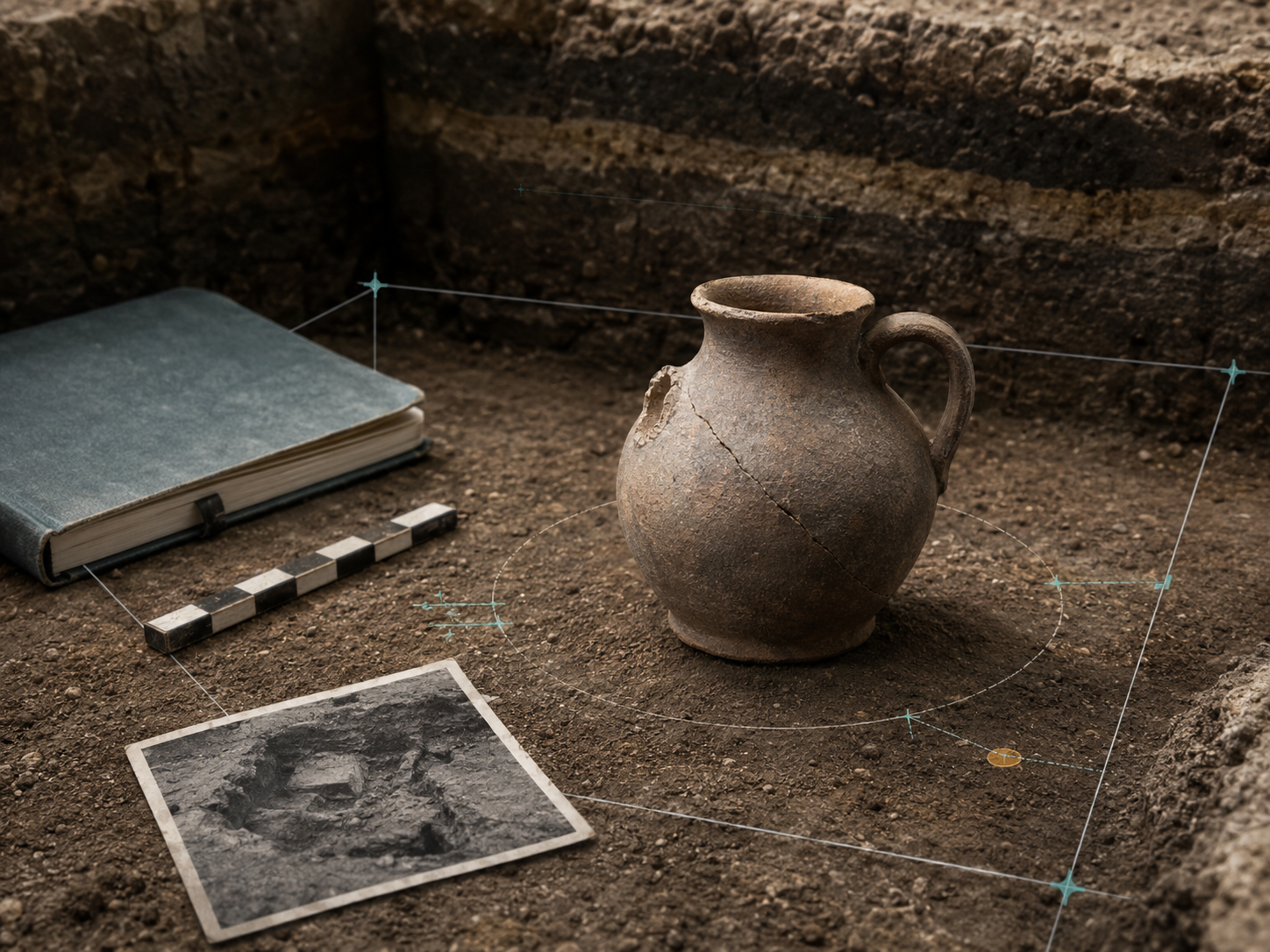 Curated path · The discovery
Passage 1 / 3
At first light, the rim of a small ceramic vessel emerges within stratigraphic unit 17. Before any removal, the field archaeologist records its coordinates, elevation and relationship to the unit.

From source to experience
The audience encounters a coherent story. At any passage, the evidence card keeps the underlying claim, source, status, rationale, responsibility and rights available for inspection.
Prototype release conditions
The demo validator requires every passage to expose an entity, claim, precise source and evidence record.
Each claim is marked as documented fact, supported interpretation or open hypothesis, with a rationale.
Authorship and review are separate fields. A reviewer can approve, return or block a narrative unit.
A real pilot must record ownership and permitted transformations before an asset enters a publishable path.
Who signs
The illustrative demo uses fictional role identifiers. In a real pilot, names, qualifications and decision rights are assigned before publication; Memory Twin Studio does not replace the scientific authority of the corpus owner.
Defines the authorised corpus, access conditions and permitted transformations.
Formulates or assesses claims, records uncertainty and preserves competing interpretations.
Turns approved claims into narrative units without changing their epistemic status.
Checks claim-to-story consistency and approves, returns or blocks publication.
For institutions
The prototype is being structured so that a future pilot can map to established heritage standards without forcing every domain into one archaeological schema. It currently claims neither formal compliance nor native integration.
Future mapping target for entities, events and provenance; not the prototype’s complete native model.
Italian catalogue records can remain authoritative sources. The RA profile is relevant to archaeology, not the universal product schema.
Methodological reference for access, reuse and governance; Memory Twin Studio does not replace institutional infrastructure.
References for transparency, method documentation, metadata and paradata in digital heritage visualisation.
Guidance for reuse, accountability, ethics and community authority; no certification is claimed.
Current status
This public page now demonstrates the minimum evidence fields, closed epistemic statuses and human release roles on a fictional corpus. A real private vertical slice still requires an authorised corpus, named scientific responsibility and validation by the source owner.
Name and research context
“Memory Twin” is also the name of an existing scholarly framework for cultural heritage documentation. Memory Twin Studio acknowledges that prior research and positions this independent Museyoum prototype as a complementary editorial and generative layer operating above already digitised or catalogued sources.
A holistic framework connecting geometry, data, metadata and paradata for cultural heritage documentation and interpretation.
The full project and brand name used by this site; it is not a claim of ownership over the scholarly term “Memory Twin”.
The prototype direction tested here: reviewed evidence → approved narrative units → adaptive cultural experiences.
Memory Twin Studio is not affiliated with, endorsed by or presented as part of the Memory Twin framework, the Memory Twin Alliance or HERITALISE. Any future relationship will be stated only after a formal agreement.

Initiated by Museyoum
Memory Twin Studio is an independent research and product initiative developed by Museyoum S.r.l. Impresa Sociale. It grows out of Museyoum’s work in digital heritage, immersive narrative and accessible cultural experiences.
Pilot projects
We are speaking with museums, archives, research groups and cultural organisations interested in testing a focused, rights-aware case.
Propose a collection Request the prototype briefEvidence behind this passage
Illustrative corpus — entities, records, roles and dates are fictional. No real collection or excavation is represented.
Minimum release fields complete